
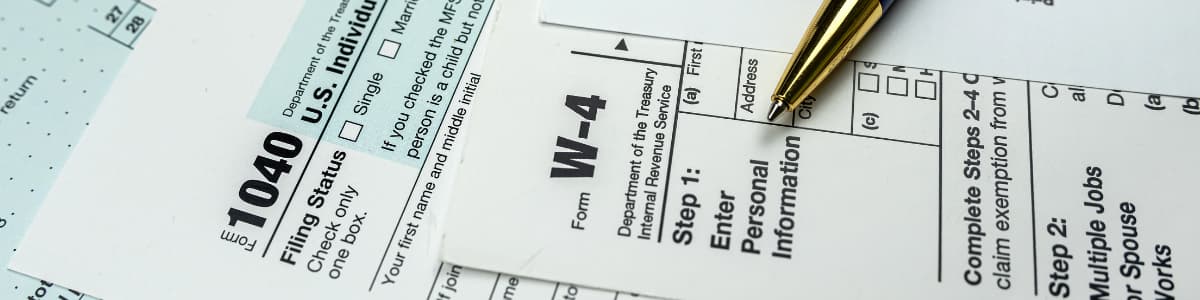
The 2026 Form W-4 — also written as W4 form 2026, 2026 W4 form, or federal W4 2026 — is the Employee’s Withholding Certificate the IRS finalized in December 2025, and it tells your employer how much federal income tax to withhold from every paycheck. It keeps the familiar five-step layout, but this year brought real changes: a higher Child Tax Credit line, a new formal exemption checkbox, and an expanded deductions worksheet tied to the One Big Beautiful Bill Act (OBBBA). Get it wrong in either direction and you either float the IRS an interest-free loan all year or land a balance due next April.
This guide walks through exactly what changed on the 2026 W-4, gives filled-out examples for the most common situations (single, married filing jointly, claiming dependents), links you straight to the official IRS PDF, and flags where payroll teams typically fall behind.
Form W-4 (2026) — also called the IRS W-4, or simply a W4 tax form — is the form employees complete so their employer can calculate correct federal income tax withholding. It has five steps — personal information/filing status, multiple jobs or working spouse, dependents and credits, other income/deductions, and signature. New for 2026: the Child Tax Credit entered in Step 3 rises to $2,200 per qualifying child (from $2,000), Step 4(b)’s deductions worksheet expands to its own page with new lines for tips and overtime pay, and there’s now a formal checkbox for claiming exempt status instead of a handwritten note. The form itself doesn’t set your final tax bill — that’s determined when you file your return.
Official source (IRS W4 2026): Form W-4 (2026), IRS.gov | About Form W-4
Looking for the w4 2026 printable version, the W-4 form 2026 PDF, or a w 4 form 2026 download free option? Always download directly from the IRS rather than a third-party site, since worksheets and figures get updated:
To adjust W-4 for 2026 withholding, download the current fillable PDF, complete it in Adobe Acrobat, and either print it for a physical signature or submit it electronically through your employer’s payroll system.
| Change | 2025 Form | 2026 Form |
|---|---|---|
| Form length | 4 pages | 5 pages (includes instructions) |
| Child Tax Credit (Step 3) | $2,000 per qualifying child | $2,200 per qualifying child |
| Credit for other dependents | $500 | $500 (unchanged) |
| Step 4 labeling | Marked “Optional” | “Optional” label removed |
| Step 4(b) Deductions Worksheet | Shared page | Expanded to its own page (15 lines), with new lines for qualified tips, qualified overtime pay, and qualified passenger vehicle loan interest |
| Claiming exempt | Handwritten “Exempt” notation | Formal exemption checkbox and certification |
2026 exempt-status deadline: if you claimed exempt in 2025 (your W4 form 2025 exempt certification), you must file a new W-4 by February 17, 2026 to keep exempt status for 2026. Miss it, and your employer must switch you to Single withholding with no Steps 2–4 entries.
If your current W-4 still matches your situation, you don’t need to refile it just because the year changed — employers keep using the most recent form on file. But if you have tip income, overtime pay, or a car loan you want reflected, the new 2026 lines are worth using.
| Term | What It Means | Why It Matters |
|---|---|---|
| W-4 withholding | Federal tax withheld from your paycheck | Funds tax payments during the year |
| Tax liability | The actual federal tax you owe | Set when your return is filed |
| Refund | Withholding exceeded liability | Sign of over-withholding |
| Balance due | Withholding fell short of liability | Sign of under-withholding |
Example: $15,000 withheld against a $13,500 liability generally shows up as a $1,500 refund. Flip it — $10,000 withheld against $13,500 owed — and you’re facing a $3,500 balance due.
| Step | What It Covers | When It Applies |
|---|---|---|
| Step 1 | Name, address, SSN, filing status | Everyone |
| Step 2 | Multiple jobs or a working spouse | Households with more than one income |
| Step 3 | Dependents and credits (Lines 3a, 3b) | If claiming the Child Tax Credit or credit for other dependents |
| Step 4 | Other income, deductions, extra withholding | Optional, situation-dependent |
| Step 5 | Signature | Everyone — unsigned forms aren’t valid |
Name, address, SSN, and anticipated filing status. Pick the status that reflects your actual tax situation, not the one that maximizes take-home pay. Single, one job, no dependents? You can likely stop after Step 1 and go straight to signing.
This is where the W-4 Multiple Jobs Worksheet applies — sometimes searched as the w4 multiple jobs worksheet, multiple jobs worksheet w4, or IRS Multiple Jobs Worksheet — for anyone with more than one job at once, or married filing jointly with a working spouse. Withholding calculated on a single job alone understates combined household income. The form gives three options: the IRS Tax Withholding Estimator, the Multiple Jobs Worksheet in the instructions, or a checkbox (accurate only when both jobs pay similarly). Self-employment income or a large pay gap between jobs is where the Estimator is worth the extra ten minutes.
Lines 3(a) and 3(b) let you claim dependents on your W-4 by splitting the dependent amount into qualifying children and other dependents:
Add lines 3(a) and 3(b) together to get your total credits for dependents, and enter that combined figure on line 3. Only claim amounts you reasonably expect to qualify for — leaving it blank doesn’t forfeit the credit, since you can still claim it on your return.
| Line | Purpose | Example |
|---|---|---|
| 4(a) Other income | Income without withholding | Interest, dividends, retirement income — including income affected by the new Social Security senior deduction |
| 4(b) Deductions | Deductions beyond the standard deduction | Itemized deductions like the SALT deduction, plus new 2026 lines for qualified tips, overtime, and vehicle loan interest |
| 4(c) Extra withholding | Flat additional amount per paycheck | Covers side income or an expected shortfall |
The W-4 Deductions Worksheet (also called the W4 worksheet, since it covers your W4 deductions) now runs 15 lines on its own page. Skip 4(b) entirely and withholding defaults to the standard deduction — the 2026 form states this explicitly. For the full calculation methodology, see IRS Publication 15-T and Publication 505.
No signature, no valid W-4. Payroll should confirm every submitted form is signed, dated, and entered before the next pay run.
Real numbers help more than instructions alone. Here are three sample W-4 examples — filled-out W-4 form scenarios you can use as a template, not tax advice for your exact situation:
Example 1 — Single, one job, no dependents: Complete Step 1 with name, address, SSN, and filing status “Single or Married filing separately.” Skip Steps 2–4 entirely. Sign and date Step 5. This is the most common W-4 example filled out, and it’s accurate for most single filers with one employer and no dependents.
Example 2 — Married filing jointly, both spouses working: Complete Step 1 with filing status “Married filing jointly.” In Step 2, either check box 2(c) if both jobs pay similarly, or use the Multiple Jobs Worksheet to calculate a more precise additional withholding amount for Step 4(c). This prevents the common under-withholding problem that happens when both spouses’ employers withhold as if theirs is the only household income.
Example 3 — Single parent with two dependents: Complete Step 1 as “Head of household” (if qualifying). In Step 3, multiply 2 qualifying children by $2,200 = $4,400 on line 3(a) (adjust if one dependent isn’t a qualifying child under 17). Enter the total on line 3, add any Step 4 adjustments if applicable, and sign.
The federal W-4 only sets federal withholding. Most states with a state income tax require a separate state withholding certificate (state W-4 equivalents like California’s DE 4 or New York’s IT-2104). A handful of states use federal withholding elections as a default, but you should confirm with your state’s department of revenue — filing only the federal form in a state that requires its own can leave your state withholding inaccurate all year.
| Situation | Why Review | Likely Action |
|---|---|---|
| New job | Withholding restarts from zero | Complete a new W-4 |
| Second job | Combined income changes the math | Revisit Step 2 |
| Marriage or divorce | Filing status and household income shift | Reassess the whole form |
| New dependent | New credit eligibility | Update Step 3 |
| Tip or overtime income | New 2026 deduction lines may apply | Review Step 4(b) |
| Large refund or balance due last year | Prior withholding was off | Adjust accordingly |
You can submit a revised W-4 any time — you don’t have to wait for tax season. The IRS Tax Withholding Estimator is the fastest way to check your numbers before resubmitting.
Form W-4, the Employee’s Withholding Certificate, is an IRS tax withholding form employees give their employer so payroll can calculate the correct amount of federal income tax to withhold from wages. It’s sometimes searched as “form w4,” “irs w4 form,” or simply “w4 tax form.”
Yes. The IRS finalized the 2026 W4 form (also called the federal W4 2026 or federal W-4 2026) in December 2025 with OBBBA-related changes, including a higher Child Tax Credit amount and an expanded deductions worksheet.
The 2026 form is one page longer, raises the Child Tax Credit entry to $2,200 per child, removes the “Optional” label from Step 4, expands the deductions worksheet to 15 lines with new tip/overtime/vehicle-loan lines, and adds a formal exemption checkbox. If you claimed exempt on the 2025 W-4 (the version on the IRS site before this update), that status doesn’t carry over automatically — you’ll need to renew it on the 2026 form by February 17, 2026.
Request the current form from your employer or download it from the IRS website — search “IRS W4” or go directly to IRS.gov — complete Steps 1 and 5 at minimum, and Steps 2–4 based on your situation (multiple jobs, dependents, other income, or extra withholding), then submit it to your payroll or HR department.
Complete Step 1 with your filing status as Single, and in most cases you can skip Steps 2–4 and go straight to signing in Step 5 — unless you have a second job, dependents, or other income to report. This covers how to fill out a W-4 single with no dependents, which is the most common scenario.
Select “Married filing jointly” in Step 1, then complete Step 2 if your spouse also works — either the checkbox method for similar-paying jobs or the Multiple Jobs Worksheet for more accuracy.
In Step 3, enter your number of qualifying children multiplied by $2,200 on line 3(a), your number of other dependents multiplied by $500 on line 3(b), and add the two for your total on line 3.
Your employer applies the IRS default withholding rules, generally treating you as Single with no additional adjustments.
Yes, in Step 4(c), as a flat extra dollar amount withheld per paycheck.
No. It only sets withholding during the year. Actual liability is calculated on your tax return, with withholding credited against it.
Yes — Formulario W-4(SP), sometimes searched as “W4 Spanish 2026,” is the official Spanish-language version for 2026, along with versions in Chinese, Korean, Russian, and Vietnamese.
February 17, 2026.
A W-4 is a small form with an outsized effect on take-home pay and your tax bill. For individuals, review it whenever your situation changes and always use the current-year worksheets. For employers, it’s a process problem: collecting updated forms, validating them, and getting them into payroll before the next run.
If your organization needs help tightening up how it handles tax withholding adjustments, KMK Ventures’ payroll management team can build a more reliable process around form collection and data entry.
It’s also worth looking at the W-4 alongside other required hire paperwork — our guides to the W-9 and W-2 cover the rest of the forms most new hires touch.
And if withholding is just one piece of a bigger year-round planning picture, KMK’s tax planning and advisory and outsourced tax services teams can help, alongside bookkeeping support and our broader guide to outsourced accounting services.
Always cross-check current figures against the official IRS Form W-4 page, the 2026 PDF, and the IRS Tax Withholding Estimator, since figures can be revised during the year.

Bert Wilson serves as our U.S. representative and client success manager, specializing in U.S. tax and accounting services. With expertise in tax compliance, financial reporting, and outsourced accounting solutions, Bert helps clients navigate complex financial challenges. Holding a Master’s degree in accounting and having obtained his C.P.A. license from the state of Colorado, he ensures client expectations are exceeded through tailored solutions and seamless collaboration with our India team. Passionate about building relationships, Bert enjoys both early mornings and outdoor sports, embodying a proactive approach to success
KMK is a top outsourced accounting and tax service provider. We offer end-to-end accounting and tax services for small to mid-sized businesses, with a team of 2000+ professionals, including certified public, chartered, and staff accountants.
Schedule a MeetingUSA:
651 N Broad ST STE 205 10055
Middletown, DE 19709
Phone: 941-877-2835
India:
300, Sankalp Square-3B
Sindhu Bhavan Marg,
Ahmedabad, Gujarat 380058
For Career: 91-98240-42996
Developed by Bluele | Copyright © 2026 | KMK Ventures Private Limited. | All Rights Reserved