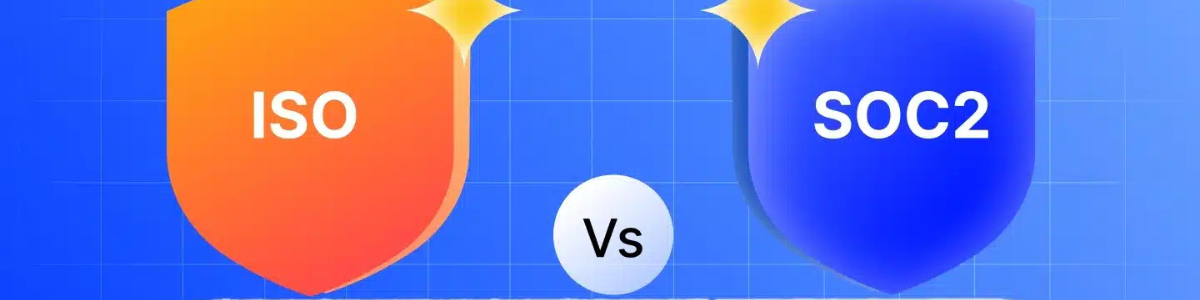
ISO 27001 is a certification that proves an organization has built and maintains a complete information security management system (ISMS). SOC 2 is an attestation report — an auditor’s professional opinion on whether specific security controls actually worked as claimed over a set period of time. ISO 27001 is issued by an accredited certification body; SOC 2 is issued by a licensed CPA firm.
If a vendor, an auditor, or a prospective client has asked whether you’re “ISO 27001 or SOC 2 compliant,” you already know these two names get used almost interchangeably — and that’s part of the problem. ISO 27001 and SOC 2 are both information security frameworks trusted around the world, but they’re built differently, audited differently, and answer different questions for the people relying on them.
This guide breaks down the real difference between SOC 2 and ISO 27001, walks through both audit types, and explains how outsourced service providers — like accounting and finance teams handling sensitive client data — typically approach both.
| ISO 27001 | SOC 2 | |
|---|---|---|
| What it is | An international certification for an Information Security Management System (ISMS) | An attestation report on a service organization’s controls |
| Issued by | Accredited ISO certification body | Licensed CPA firm (US) or equivalent chartered accountancy body |
| Output | A certificate (pass/fail) | A detailed audit report (auditor’s opinion) |
| Basis | ISO/IEC 27001 standard, Annex A controls | AICPA Trust Services Criteria (Security, Availability, Processing Integrity, Confidentiality, Privacy) |
| Audit window | Point-in-time / annual surveillance | Type 1: a single date. Type 2: 3–12 months of evidence |
| Primary geography | Global, especially EU, UK, APAC | Historically US-centric, now globally recognized |
| Typical timeline | 3–6 months to first certification | 2–3 months (Type 1), 6–12 months (Type 2, including observation period) |
| Renewal | 3-year cycle with annual surveillance audits | Re-issued every 12 months |
Neither one is objectively “better.” ISO 27001 vs SOC 2 really comes down to what your customers, regulators, or contracts require — and many mature organizations eventually hold both.
ISO 27001 is an international standard maintained by the International Organization for Standardization. It doesn’t certify a single product or service — it certifies that an organization has built and maintains an ISMS (Information Security Management System): a structured, ongoing program covering risk assessment, security controls, policies, and continual improvement.
To become iso 27001 accredited, an organization must:
The result is a certificate — a straightforward signal that an accredited third party has verified your ISMS meets the standard. It’s also why so many outsourced service providers point to ISO 27001 as the backbone of their data security programs: the standard forces the same rigor around client data that internal IT and finance teams expect from an in-house provider.
SOC 2 (System and Organization Controls 2) is an American framework developed by the AICPA. It’s not a certification in the ISO sense — it’s an attestation report, written as the auditor’s professional opinion on how well your controls actually operated.
SOC 2 audits are measured against five Trust Services Criteria: Security, Availability, Processing Integrity, Confidentiality, and Privacy. Most organizations only need to include Security (the mandatory criterion) plus whichever others are relevant to their business.
There are two report types, and this is where a lot of the confusion around “soc ii type 2” comes from:
Most enterprise customers and procurement teams ask specifically for a SOC 2 Type 2 report, since it demonstrates sustained performance rather than a one-day snapshot. It’s worth noting the same Type 1 / Type 2 structure exists for SOC 1 reports too — SOC 1 Type 2 vs Type 1 follows the identical logic, just applied to controls over financial reporting rather than security.
There’s also SOC 3, a public-facing, sanitized version of a SOC 2 report that companies can publish on their website without an NDA, and SOC frameworks extended to supply chain risk (often referred to as SOC for Supply Chain) for organizations that manufacture or handle physical goods. For US companies running distributed delivery teams — including offshore or Global Capability Center models — SOC 2 is usually the report a domestic customer or auditor will ask for first, since it’s built around a US accounting framework.
ISO 27001 is a management-system standard. It asks: “Do you have a repeatable, risk-based process for managing information security?” The controls you choose depend on your own risk assessment, which is documented in a Statement of Applicability.
SOC 2 is a controls-and-evidence exercise. It asks: “Did the specific controls you claim to have actually work, consistently, over this period?” There’s no single fixed control list — your auditor tests the controls you’ve mapped to the Trust Services Criteria you selected.
This is the single biggest iso 27001 vs soc 2 differences point people miss. ISO 27001 results in a certificate — a pass/fail outcome issued under a formal accreditation scheme. SOC 2 results in a report containing the auditor’s opinion, evidence samples, and any exceptions found. A SOC 2 report reads more like a detailed audit narrative; an ISO 27001 certificate is closer to a stamp of approval backed by an underlying audit trail your assessor can request to see.
ISO 27001 certification must come from an accredited certification body recognized by a national accreditation authority. SOC 2 attestation can only be performed by a licensed CPA firm in the US, or an equivalent chartered accountancy body internationally.
SOC 2 remains the default expectation for SaaS and technology vendors selling into North America. ISO 27001 is the dominant standard across the UK, EU, and much of Asia-Pacific, and it’s frequently a hard requirement in government and enterprise RFPs outside the US. Global companies — and outsourced service providers working across both markets — often need to satisfy both.
A first-time SOC 2 Type 1 can often be completed in 2–3 months. SOC 2 Type 2 takes longer because the observation window itself typically runs 3–12 months before the report can even be issued. ISO 27001 implementation generally takes 3–6 months before the certification audit, plus ongoing surveillance audits every year after that. Cost varies widely by organization size and scope, but SOC 2 audits tend to be priced per engagement while ISO 27001 involves both certification body fees and, often, a heavier internal documentation lift up front. That documentation lift usually overlaps with an organization’s existing quality control processes, which is one reason teams that already run a mature QC function tend to move through ISO 27001 implementation faster.
Since defense contractors and their suppliers increasingly ask about this, it’s worth a quick note on CMMC vs ISO 27001. CMMC (Cybersecurity Maturity Model Certification) is a US Department of Defense requirement specifically for the Defense Industrial Base, built around NIST SP 800-171 controls tied to Controlled Unclassified Information (CUI). ISO 27001 is a general-purpose, industry-agnostic ISMS standard with no government mandate behind it. They overlap heavily in underlying controls, and many organizations use an existing ISO 27001 ISMS as the backbone for CMMC readiness — but CMMC assessments follow their own separate certification process and aren’t interchangeable with an ISO 27001 certificate. This kind of framework-stacking shows up across other regulated sectors too, which is part of why compliance requirements vary so much across the industries we serve.
Increasingly, yes — especially SaaS and cybersecurity vendors selling to both US and international enterprise customers. It’s common practice for identity and access management platforms, secrets-management tools, and other cybersecurity tools in a modern vendor stack to publish both a SOC 2 report and ISO 27001 certification in their trust center. Auth0, for example, undergoes an annual SOC 2 Type 2 audit covering all five Trust Services Criteria and also holds ISO 27001 certification. For buyers running vendor due diligence, seeing both is generally treated as a stronger trust signal than either one alone, since the two frameworks test different things: one confirms you have a managed security program (ISO 27001), the other confirms your controls actually functioned as claimed over time (SOC 2). The same logic applies outside of pure SaaS — outsourced finance and accounting partners are increasingly expected to show the same layered proof, which you can read more about in our company overview.
Ask three questions:
For many growing companies — and especially outsourced service providers handling sensitive financial or client data — the realistic end state is both. A well-run ISMS under ISO 27001 makes it considerably easier to gather the evidence a SOC 2 Type 2 audit demands, since the risk assessment, access controls, and incident response processes largely overlap. This is especially relevant if you’re relying on a partner for offshore staffing or virtual CFO services — both involve handing over meaningful access to financial systems, so it’s worth confirming which certifications that partner actually holds before you sign anything.
If you’re evaluating an outsourced accounting or finance partner, iso 27001 vs soc 2 isn’t an academic distinction — it directly affects how confidently you can hand over sensitive financial records, payroll data, and banking details. Ask any potential partner:
At KMK Ventures, data security isn’t a bolt-on — it’s built into how we deliver outsourced tax services for US-based businesses and CPA firms. We’re an ISO/IEC 27001:2022 certified organization, and that certification shapes how our teams vet staff, segregate client environments, and handle sensitive financial data on every engagement.
If you’re weighing up a partner and want the honest reasoning behind these questions rather than a sales pitch, it’s worth reading why businesses choose KMK before you shortlist anyone.
No. SOC 2 is an attestation report from a CPA firm evaluating specific controls against the AICPA’s Trust Services Criteria. ISO 27001 is a certification confirming an organization has implemented a full Information Security Management System (ISMS) that meets an international standard. They test different things and are issued by different types of assessors.
Neither is universally “harder.” SOC 2 Type 2 requires a long observation period (often 6–12 months) before the report can be issued, which extends the timeline. ISO 27001 requires building a full management system with documented risk assessments and controls, which can mean more upfront structural work. Many organizations find the two roughly comparable in total effort.
Yes, and it’s increasingly common, particularly for SaaS companies and outsourced service providers selling into both US and international markets. The two frameworks share a lot of underlying control requirements, so an existing ISO 27001 ISMS significantly reduces the extra work needed for a SOC 2 Type 2 report.
Type 1 evaluates whether controls are designed correctly at a single point in time. Type 2 evaluates whether those controls operated effectively over an extended period, typically 3–12 months. Most enterprise buyers request Type 2 because it demonstrates sustained performance rather than a snapshot.
Yes, both require ongoing work. SOC 2 reports are typically reissued every 12 months to cover a new audit period. ISO 27001 certificates are valid for three years but require annual surveillance audits to remain active.
Neither is a legal requirement on its own. Both are voluntary frameworks, though specific industries, contracts, and jurisdictions may require one or both as a condition of doing business — particularly in finance, healthcare, government contracting, and enterprise SaaS.

Bert Wilson serves as our U.S. representative and client success manager, specializing in U.S. tax and accounting services. With expertise in tax compliance, financial reporting, and outsourced accounting solutions, Bert helps clients navigate complex financial challenges. Holding a Master’s degree in accounting and having obtained his C.P.A. license from the state of Colorado, he ensures client expectations are exceeded through tailored solutions and seamless collaboration with our India team. Passionate about building relationships, Bert enjoys both early mornings and outdoor sports, embodying a proactive approach to success
KMK is a top outsourced accounting and tax service provider. We offer end-to-end accounting and tax services for small to mid-sized businesses, with a team of 2000+ professionals, including certified public, chartered, and staff accountants.
Schedule a MeetingUSA:
651 N Broad ST STE 205 10055
Middletown, DE 19709
Phone: 941-877-2835
India:
300, Sankalp Square-3B
Sindhu Bhavan Marg,
Ahmedabad, Gujarat 380058
For Career: 91-98240-42996
Developed by Bluele | Copyright © 2026 | KMK Ventures Private Limited. | All Rights Reserved