
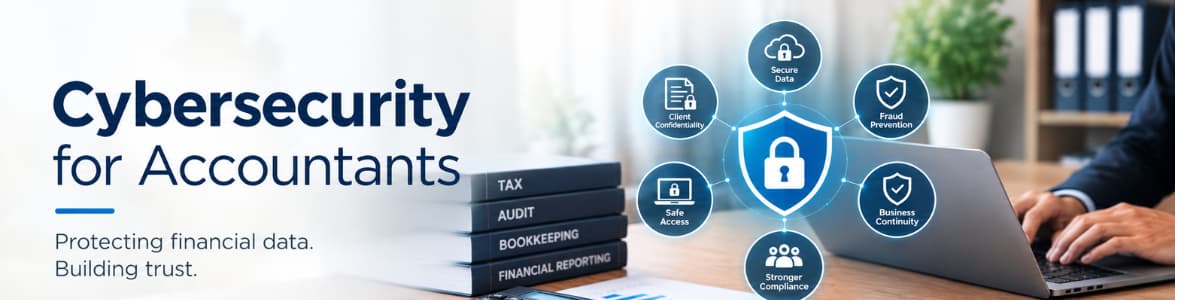
In October 2026, regulatory scrutiny around non-public personal information (NPI) has reached an all-time high. With the SEC enforcing strict four-day material incident reporting guidelines and state-level privacy mandates expanding, firms utilizing third-party accounting providers must enforce zero-trust security architecture across all external connections.
Evaluating an outsourced accounting partner requires verifying SOC 2 Type II compliance, end-to-end data encryption, and strict multi-factor authentication (MFA). A robust security framework ensures third-party bookkeepers and CPAs handle sensitive tax records, bank credentials, and general ledger access under rigorous regulatory standards without exposing your firm to third-party data breaches.
This guide helps CPAs, CFOs, and managing partners evaluate the data security posture of outsourced accounting vendors. Readers will discover operational checklists for vetting third-party access, auditing remote workforce hygiene, managing compliance requirements, and establishing proper accounting controls for cyber incident recovery costs.
Outsourcing bookkeeping, tax prep, and month-end closes offers clear operational scale, but passing client general ledgers to third parties introduces vendor risk. Implementing robust cybersecurity for accountants is essential when external teams access sensitive tax records, payroll feeds, and banking portals. Whether you use outsourced accounting services for one client or fifty, vendor access needs the same scrutiny.
Modern cyber security and accounting operations depend on uncompromised data integrity. Without strong administrative controls and encrypted channels, outsourcing can expose firms to data breaches, wire fraud, and regulatory penalties. Protecting non-public personal information requires verifying that external partners adhere to strict cybersecurity best practices for accounting professionals.
Outsourced financial operations create expanded attack surfaces. When an external partner accesses your tech stack, their security posture directly impacts your overall risk profile.
Understanding cybersecurity challenges in outsourced accounting requires identifying where operational handoffs occur. Threat actors frequently exploit weak vendor remote-access setups rather than targeting primary firm infrastructure.
| Vulnerability Vectors | Operational Risk Level | Primary Risk Exposure | Mitigation Requirement |
|---|---|---|---|
| Shared Staff Credentials | High | Unauthorized account takeover and data theft | Mandatory SSO with role-based access control |
| Unencrypted Email Transmittals | High | Interception of tax documents and W-2 data | Enforced encrypted client portals for document sharing |
| Unvetted Personal Devices | Medium | Malware infection and keylogging | Strict Mobile Device Management (MDM) enforcement |
| Generic Third-Party Software | High | Supply chain attacks via unpatched tools | Quarterly vendor risk reviews and software audits |
Addressing the rise of cybercrime against accountants requires eliminating loose credential sharing. Third-party contractors should never access general ledgers via unmonitored accounts. Mandatory single sign-on (SSO), restricted IP access, and continuous monitoring prevent unauthorized access.
Evaluating an outsourced team requires inspecting operational controls. A reliable vendor offering a dedicated cybersecurity service for accountants should demonstrate clear operational protocols rather than offering generic verbal assurances.
When reviewing a provider’s infrastructure, verify these essential operational benchmarks:
A practical scenario illustrates the necessity of this operational oversight: A mid-sized firm contracts an external team to process payroll without checking device management controls. If a remote contractor accesses payroll systems from an unpatched personal laptop, malware can capture executive banking details. Establishing mandatory MDM policies prevents unmanaged endpoints from connecting to firm ledgers.
When security incidents occur, accounting teams must manage both technical recovery and financial reporting. Properly managing accounting for cybersecurity incidents involves distinguishing immediate operational expenses from long-term capital assets under frameworks like FASB ASC 350-40.
| Expense Category | Accounting Treatment | Included Cost Examples | Financial Impact |
|---|---|---|---|
| Immediate Operating Expenses | Expensed as Incurred | Forensic audits, legal retainers, breach notification costs, public relations crisis management | Directly impacts current-period net income on the P&L |
| Capitalizable System Upgrades | Capitalized under ASC 350-40 | Core infrastructure redesign, major security software development, permanent system architecture overhauls | Amortized over the useful life of the new system asset |
Immediate forensic investigations, breach notification mailers, crisis communications, and legal retainers must be expensed as incurred. Conversely, major post-incident platform overhauls or new software architecture may qualify for asset capitalization if they deliver long-term operational improvements.
Beyond financial records, firms must evaluate what is cyber accounting in practice: the discipline of measuring cyber risk exposures, managing breach liability reserves, and maintaining compliant records for SEC, IRS, or state regulatory bodies.
Managing risk across expanding client bases requires robust administrative technology. Evaluating specialized cybersecurity platforms for medium accounting firms involves selecting systems that automate threat monitoring and measure risk exposure across all connected endpoints.
Finance leaders should deploy a centralized cyber risk measurement platform for accounting firms to assess security scores, track compliance status, and flag unpatched software across internal and vendor systems.
| Platform Requirement | Technical Metric | Operational Business Outcome |
|---|---|---|
| Threat Telemetry & Logging | 24/7 SIEM / SOC Monitoring | Immediate detection of anomalous file access or remote logins |
| Access Management | Conditional MFA & SSO Protocols | Prevents password-sharing and restricts access by location/device |
| Continuous Risk Scoring | Automated Vulnerability Assessments | Real-time visibility into vendor security compliance gaps |
| Incident Response Readiness | Automated System Lockdown Controls | Instantly isolates compromised accounts during security events |
Deploying tailored cybersecurity for accounting firms provides structured risk visibility. Rather than guessing whether an outsourced team adheres to security protocols, continuous monitoring tools deliver verifiable security metrics across every connection.
A firm’s public web infrastructure serves as a primary access point for client data. Prioritizing enhancing website security for CPAs requires moving away from outdated web forms toward secure, encrypted client portals built on secure cloud infrastructure.
Comprehensive cybersecurity and privacy best practices for accountants require establishing clear administrative controls across all digital touchpoints:
Implementing these measures protects firm assets, upholds professional standards, and keeps client data secure across every engagement.
KMK Ventures delivers outsourced accounting, bookkeeping, and tax support built on secure financial operations. We understand that accounting outsourcing requires uncompromising data protection, transparent administrative controls, and strict compliance alignment. Our team operates within enterprise-grade security frameworks featuring SOC-compliant infrastructure, mandatory multi-factor authentication, role-based access management, and continuous threat monitoring. By blending rigorous operational workflows with skilled accounting talent, KMK ensures your financial data stays confidential, accurate, and fully compliant. Partnering with KMK allows CPAs, CFOs, and finance leaders to scale operational capacity confident that their clients’ sensitive financial records remain protected.
Outsourcing financial workflows provides operational agility, but maintaining data security requires constant oversight. Protecting client ledgers demands enforcing strict administrative controls, auditing third-party access, and standardizing end-to-end encryption across all file transfers. Establishing clear vendor management protocols allows firms to scale capacity without increasing risk. Partnering with KMK and investing in robust security controls today safeguards your reputation, ensures regulatory compliance, and protects long-term firm value. If you’re evaluating partners, talk to our team about how we protect client data.
The biggest risk involves unmanaged credential sharing and weak access controls on vendor devices. Without single sign-on, conditional access rules, and multi-factor authentication, remote contractor endpoints can become gateways for credential theft and unauthorized system access.
IRS Publication 4557 requires tax professionals to protect client data through a written information security plan (WISP). When outsourcing, firms must verify that external partners enforce equivalent security controls, including encryption, access restrictions, and background checks.
Immediate remediation expenses—such as legal retainers, forensic investigations, and credit monitoring services—are expensed as incurred. Infrastructure rebuilds, software enhancements, or permanent system redesigns following a breach may be capitalized under ASC 350-40 guidelines if they provide long-term utility.
Consumer cloud storage services often lack fine-grained access logs, automated retention enforcement, and zero-knowledge encryption protocols. Professional firm portals ensure client tax records, payroll files, and financial statements remain encrypted in transit and at rest with complete access audit trails.
Firms should conduct formal security audits of outsourced partners annually and review access permissions quarterly. Additional evaluations should occur whenever the vendor updates core software platforms or modifies data processing workflows.
Still have questions? That’s where KMK comes in. Whether you need to secure your outsourced workflows, streamline month-end close procedures, or strengthen financial reporting controls, our experienced team is ready to help. Contact KMK Ventures today to learn how our secure accounting services support and protect your business. Talk to an expert today!

Bert Wilson serves as our U.S. representative and client success manager, specializing in U.S. tax and accounting services. With expertise in tax compliance, financial reporting, and outsourced accounting solutions, Bert helps clients navigate complex financial challenges. Holding a Master’s degree in accounting and having obtained his C.P.A. license from the state of Colorado, he ensures client expectations are exceeded through tailored solutions and seamless collaboration with our India team. Passionate about building relationships, Bert enjoys both early mornings and outdoor sports, embodying a proactive approach to success
KMK is a top outsourced accounting and tax service provider. We offer end-to-end accounting and tax services for small to mid-sized businesses, with a team of 2000+ professionals, including certified public, chartered, and staff accountants.
Schedule a MeetingUSA:
651 N Broad ST STE 205 10055
Middletown, DE 19709
Phone: 941-877-2835
India:
300, Sankalp Square-3B
Sindhu Bhavan Marg,
Ahmedabad, Gujarat 380058
For Career: 91-98240-42996
Developed by Bluele | Copyright © 2026 | KMK Ventures Private Limited. | All Rights Reserved