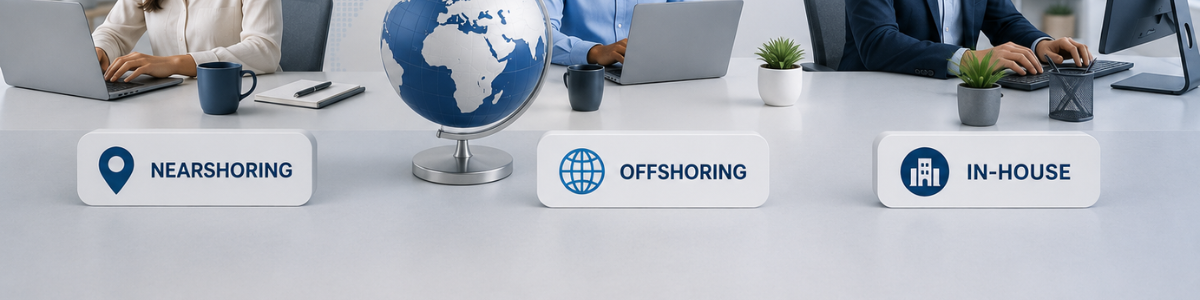
In-house accounting keeps your finance team on your own payroll with full control but the highest cost. Offshoring moves accounting work to a distant, lower-cost country like India or the Philippines, trading some real-time collaboration for savings. Nearshoring sits in between — outsourcing to a nearby time-zone-aligned country, combining offshore-level cost savings with in-house-level responsiveness. The right choice depends on your budget, how much real-time collaboration your team needs, and how fast you plan to scale.
Choosing between nearshoring vs offshoring vs in-house accounting is one of the most consequential decisions a growing business or CPA firm will make. Get it right, and you free up cash flow, close your books faster, and scale without a hiring headache. Get it wrong, and you’re stuck with a bloated payroll, a disengaged outsourced team, or a finance function that can’t keep up with your growth.
This guide breaks down all three models in plain terms, compares them side by side, and gives you a framework for deciding which one fits your business in 2026.
In-house accounting means hiring accountants, bookkeepers, and controllers directly onto your payroll, working from your office (or remotely, but as W-2 employees). It’s the traditional model, and it still makes sense for companies that need constant, real-time financial decision-making tied directly into daily operations.
Pros:
Cons:
If your business is weighing this against outsourcing entirely, it’s worth first understanding what your accounting services actually need to cover — from bookkeeping and accounts payable to payroll management — before deciding who should own each function.
Offshoring means relocating accounting and finance functions to a service provider in a distant country — typically India, the Philippines, or Eastern Europe — where labor costs are significantly lower than in the U.S.
This is the model that unlocks the deepest cost savings. It’s also where offshoring vs nearshoring conversations usually start, because offshoring was the original “outsource it overseas” playbook long before nearshoring became popular.
Pros:
Cons:
Offshoring works especially well for firms that need scalable staffing during tax season or a dedicated back-office team handling high-volume transactional work without adding U.S. headcount.
Nearshoring meaning, in simple terms: partnering with a team in a nearby or similar-time-zone country rather than a distant one. For a U.S. business, that typically means Latin America (Mexico, Colombia, Costa Rica); for a European business, it might mean Eastern Europe or North Africa.
What is nearshoring in business terms? It’s a middle-ground outsourcing strategy — you still get outsourced cost savings, but your team works during your business hours, speaks your language fluently, and can collaborate in real time the way an in-house employee would.
Pros:
Cons:
| Factor | In-House | Offshoring | Nearshoring |
|---|---|---|---|
| Cost | Highest | Lowest | Moderate |
| Time Zone Alignment | Full | Limited/overnight | High |
| Communication & Language | Native | Requires strong SOPs | Strong, often bilingual |
| Talent Pool | Smallest, local | Largest, global | Mid-sized, regional |
| Scalability | Slow, hiring-dependent | Fast and elastic | Fast, but more limited than offshore |
| Data Security Oversight | Direct | Varies by region/provider | Compliant with strong U.S.-aligned practices |
| Best For | High-touch strategic decisions | High-volume, repeatable tasks & seasonal spikes | Ongoing collaboration-heavy work |
For most growing businesses, the actual answer isn’t “pick one” — it’s a hybrid: keep review, sign-off, and client-facing judgment calls in-house, and route transactional and process-heavy work to an outsourced or nearshore Client Accounting Advisory Services team.
The nearshore vs. offshore outsourcing debate really comes down to three things:
Many firms don’t have to choose just one — a scalable offshoring and nearshoring staffing solution lets you route repeatable, high-volume work offshore while keeping collaboration-heavy functions nearshore or in-house.
These terms get mixed up constantly, so here’s a clean breakdown:
Reshoring advantages and disadvantages:
For accounting specifically, full reshoring is rare — most firms that reshore keep judgment-heavy, client-facing work onshore while nearshoring or offshoring the transactional volume.
Nearshoring trends have accelerated well beyond accounting. IT nearshoring is now common for software development teams that need overlapping hours with U.S. or European product teams. Nearshore manufacturing and nearshoring supply chain strategies have grown as companies diversify away from single-region dependency after recent global disruptions. In nearshoring Europe, businesses in countries like Germany and the UK increasingly look to nearby markets — including nearshoring France and nearshoring Austria — for both manufacturing and knowledge-work outsourcing, mirroring what U.S. firms are doing with Latin America.
For accounting and finance specifically, the trend is toward hybrid models: routine, high-volume work goes offshore for cost efficiency, judgment-heavy and collaboration-heavy work goes nearshore or stays in-house, and firms increasingly use a Global Capability Center structure to blend both under one governed, standardized team rather than juggling multiple vendors.
The core nearshoring benefits for finance and accounting functions:
Ask yourself these questions before deciding between nearshoring, offshoring, and in-house accounting:
Most businesses land on a blended model rather than an all-or-nothing choice — and that’s usually the right answer.
KMK Ventures works with U.S. businesses and CPA firms as an extension of their finance department — not a distant vendor. Whether you need offshore staffing for CPA firms, a fully outsourced accounting department, or targeted support like Virtual CFO Services, our team is built to plug into your existing workflows.
We serve a wide range of industries — from real estate and wholesale distribution to VC-backed startups — and our results are backed by real case studies from businesses that made the switch. If you’re evaluating your options, our team can walk you through what a nearshore, offshore, or hybrid model would actually look like for your business. Schedule a consultation to get started.
In-house accounting is handled by your own employees; offshoring outsources work to a distant, lower-cost country; nearshoring outsources work to a nearby, time-zone-aligned country. Each trades off cost, control, and collaboration differently.
Nearshoring means outsourcing work to a company in a nearby country, so your outsourced team can work during hours that overlap with yours.
Yes, nearshoring is typically less expensive than hiring in-house staff, though it usually costs more than offshoring to a distant, lower-cost country.
Reshoring means bringing previously outsourced work back to your home country entirely. Nearshoring keeps the work outsourced, just to a geographically closer location.
It depends on the task. Offshoring is generally better for high-volume, repetitive work where cost matters most. Nearshoring is better for work that requires frequent, real-time collaboration.

Bert Wilson serves as our U.S. representative and client success manager, specializing in U.S. tax and accounting services. With expertise in tax compliance, financial reporting, and outsourced accounting solutions, Bert helps clients navigate complex financial challenges. Holding a Master’s degree in accounting and having obtained his C.P.A. license from the state of Colorado, he ensures client expectations are exceeded through tailored solutions and seamless collaboration with our India team. Passionate about building relationships, Bert enjoys both early mornings and outdoor sports, embodying a proactive approach to success
KMK is a top outsourced accounting and tax service provider. We offer end-to-end accounting and tax services for small to mid-sized businesses, with a team of 1200+ professionals, including certified public, chartered, and staff accountants.
Schedule a MeetingUSA:
651 N Broad ST STE 205 10055
Middletown, DE 19709
Phone: 941-877-2835
India:
300, Sankalp Square-3B
Sindhu Bhavan Marg,
Ahmedabad, Gujarat 380058
For Career: 91-98240-42996
Developed by Bluele | Copyright © 2026 | KMK Ventures Private Limited. | All Rights Reserved